[ Case 01 ]
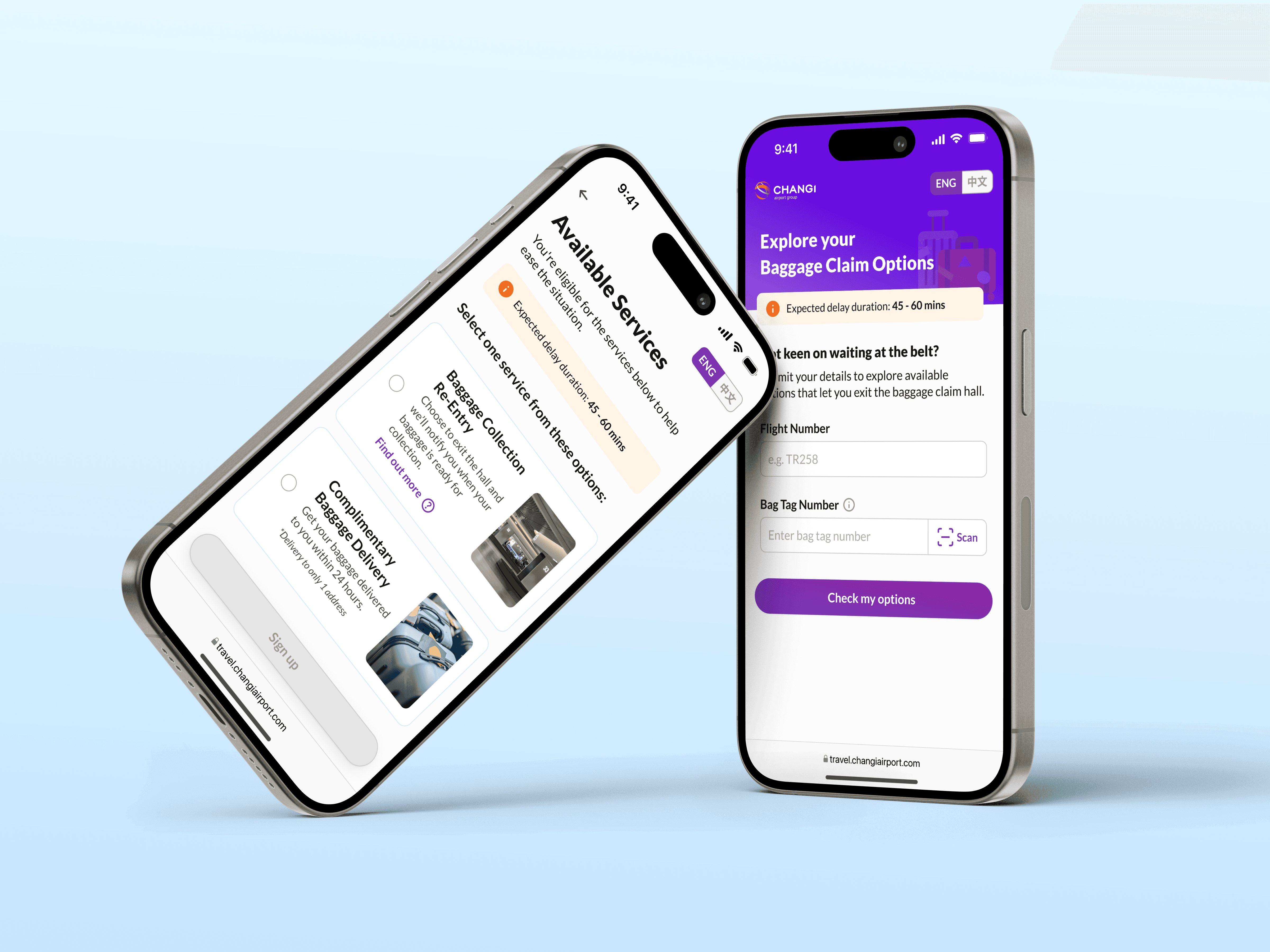
Reducing Frustation During Delays — 2x More Flexibility for Passengers
Travel
Reducing Frustation During Delays — 2x More Flexibility for Passengers
1 seamless experience for passengers, enabled by 3 staff portals
[Problem Statement]
Baggage delays of up to 2 hours left over 200 passengers stuck in the overcrowded baggage claim hall, forcing many to sit on the floor. What should have been a routine arrival became a stressful ordeal.
[Project Overview]
As lead designer, I led another designer in reimagining the baggage claim experience into a seamless passenger journey, supported by 3 staff portals.
Our goal was to allow passengers to:
Exit the baggage hall during delays
Receive notifications when bags are ready
Return smoothly, without compromising airport security or operations
[Industry]
Travel
[My Role]
Lead Designer
[Platforms]
Desktop and Mobile
[Timeline]
August 2024- October 2024
Due to project sensitivity, designs aren't shared publicly. Reach out to learn more!
[Outcome]
Boosted passenger flexibility 3× by centralising all exit options into one streamlined page
Led design from discovery to delivery across 1 passenger platform and 3 staff portals
Designed for scale, supporting 200+ passengers per hour with minimal staff input
[Process]
[01] User Research
Interviewed 15+ enablers to uncover operational needs.
Mapped journey flows and edge cases (e.g. elderly, kids).
Piloted new recruitment channels and conducted guerrilla testing with passengers in the baggage hall.
[03 Design Solution]
Built 4 interfaces (1 passenger-facing, 3 staff portals).
Reduced registration from 4 to 3 steps.
Integrated with existing systems to reduce platform bloat.
[04] Testing & Iteration
Ran usability testing and made 5+ rapid design iterations, with some turned around in under 1 day.
Adjusted copy, flow logic, and screen layout.
Ran A/B testing to ensure clarity of language.
[Key Learnings]
Simplicity wins in high-stress contexts
Reducing steps, clarifying language, and consolidating services had a bigger impact than flashy features — especially when users are tired, stressed, or confused.
Designing for real-world edge cases is non-negotiable
Planning for non-ideal flows early on helped create flows that are truly resilient, research uncovered hidden issues and ensured the design met user needs.
Iterative testing pays off
Regular testing uncovered hidden issues and ensured the design met user needs.