[Case 03]
AirAsia SuperApp redesign takes flight with a 75% increase in user engagement
Travel
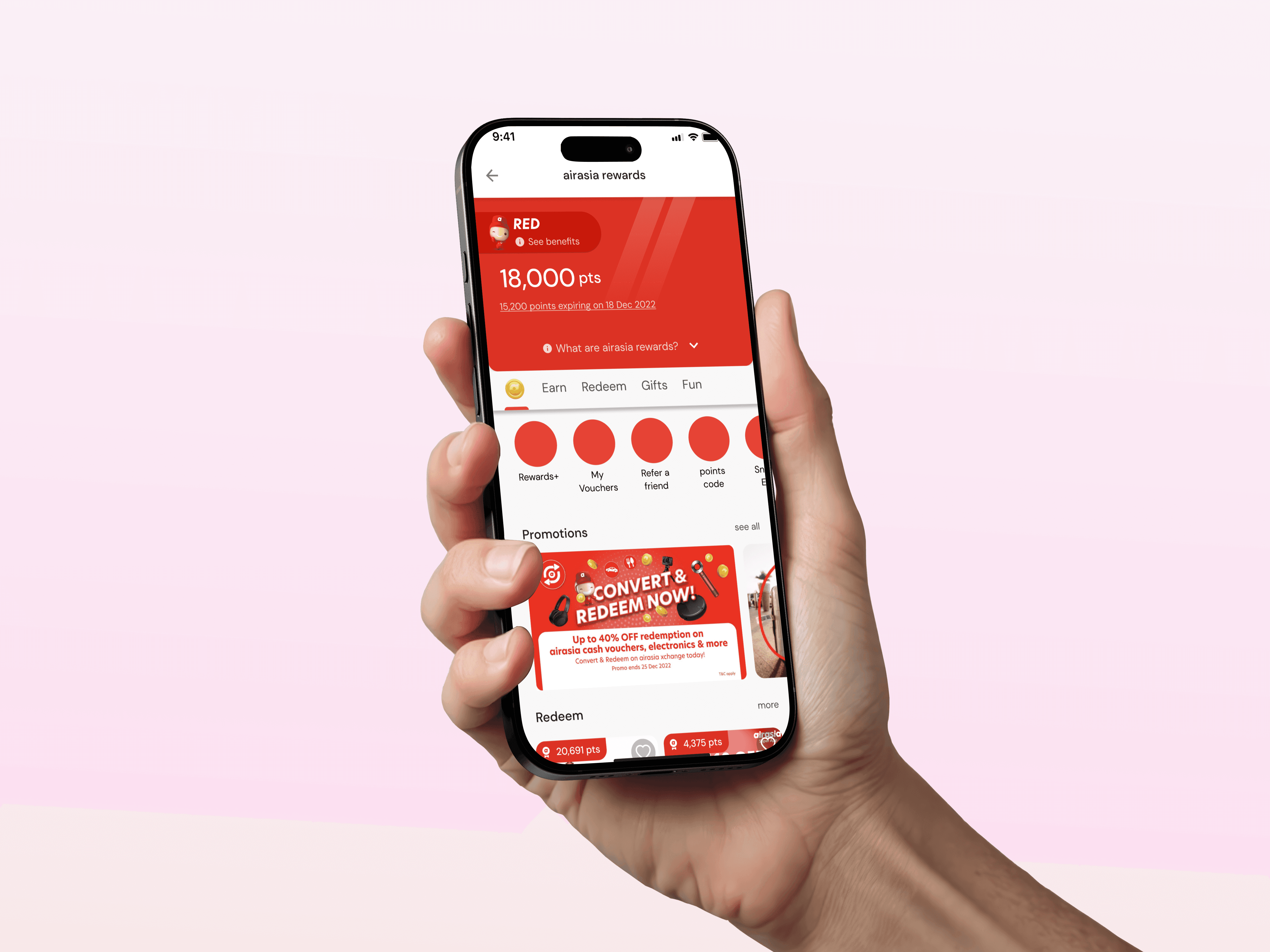
Fewer Clicks, More Clarity: Redesigning AirAsia Rewards for Scalable Redemption
Reduced key flows from 5 to 2 clicks, cleaned up 60% of visual clutter, and unified desktop and mobile into a single modular system.
[Project Overview]
AirAsia Rewards is a loyalty platform where users redeem points for flights, lifestyle deals, and travel perks. The old experience confused users with vague labels, unclear calls to action, and poor hierarchy — leading to friction, missed redemptions, and frustrated users.
Users didn’t understand how to redeem points or what they were eligible for
Key CTAs like “Use Now” were either buried or overloaded with competing messages
Business and marketing teams had conflicting content needs, adding clutter to core user flows
Visual inconsistency between desktop and mobile added to user confusion
[Industry]
Travel
[My Role]
Lead Designer (Consultant)
[Platforms]
Mobile
[Timeline]
Oct 2022 - Nov 2022
Due to project sensitivity, designs aren't shared publicly. Reach out to learn more!
[Outcome]
60% reduction in cognitive load on main rewards page (based on layout audit and CTA mapping)
Simplified redemption flow — from 5 clicks to 2 in key journeys
Improved content clarity through redesigned IA and CTA hierarchy
[01] User Research
Evaluated 10+ competitor loyalty programs for layout and redemption clarity
Conducted a heuristic audit of the current platform
Mapped out 4+ user journeys to identify blockers in point discovery and usage
[03 Design Solution]
Created a new rewards dashboard surfacing balance, redemptions, and status in one glance
Replaced vague CTAs with clear, action-oriented language (e.g. “Redeem Now” vs. “Explore”)
Proposed a tabbed layout to separate AirAsia-specific and partner rewards
[04] Testing & Iteration
Proposed 3 versions of the dashboard layout, converging on the one that balanced surfacing points, redemptions, and expiring rewards
Conducted UI audits and journey walkthroughs with stakeholders across Product, Loyalty, and Marketing
Identified friction in existing flows through label confusion mapping and CTA overload analysis
[Key Learnings]
Structure = Freedom
A strong IA and layout system allowed us to give business teams the flexibility they needed without compromising user experience.
Language Clarity Is Just as Critical as Design
Small label changes (like replacing “My Wallet” with “My Rewards”) had major impacts on wayfinding and user confidence.
Designing for Modularity Future-Proofs the Experience
Building plug-and-play layouts for promos and rewards ensured the platform could evolve without constant redesigns.